If you ever wanted to build your own CRM, part 1: a home organizing business in 20 minutes
This is a series where I build real CRMs for real kinds of businesses, on camera, from nothing — because "customizable" is the most abused word in software, and the only honest way to prove it is to build in public and let you time me.
Today: a home organizing company. Projects and recurring clients, contracts instead of estimates, a crew that works in clients' homes all over town. The kind of business that has never once fit inside a CRM. Twenty minutes. Let's go.
Minute 0–2: Install the Blueprint
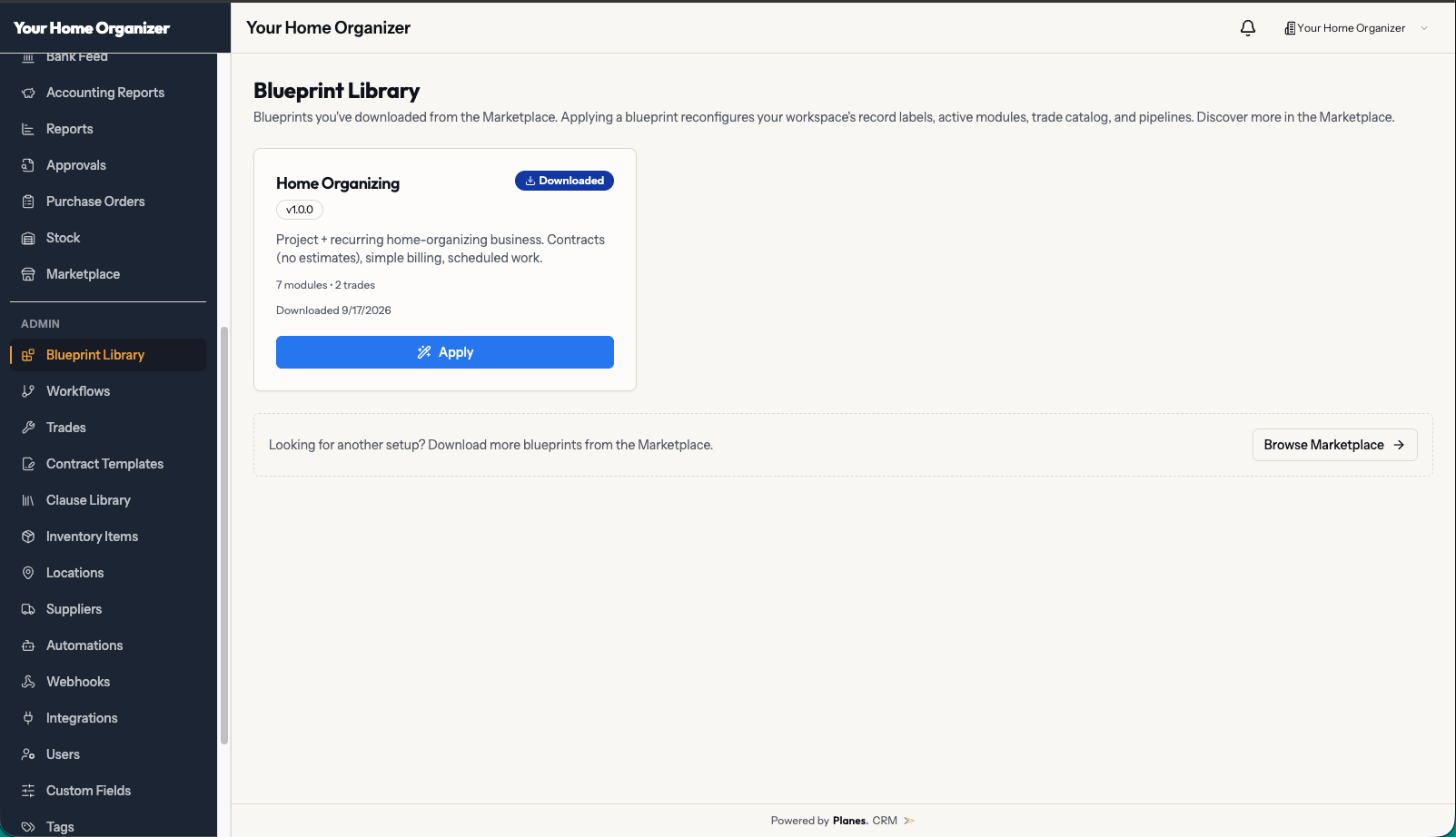
A Blueprint is a starting point, not a cage — it installs a business shape you're about to bend. One click and Planes sets up a client pipeline (lead → consult → contract → won), a job pipeline for the work itself, contracts-first paperwork, and sample data so nothing is a blank page.
Already this beats most software's "customization": we're starting from an organizing business, not from a sales funnel with the word "deal" everywhere.
Minute 2–6: Rename the world
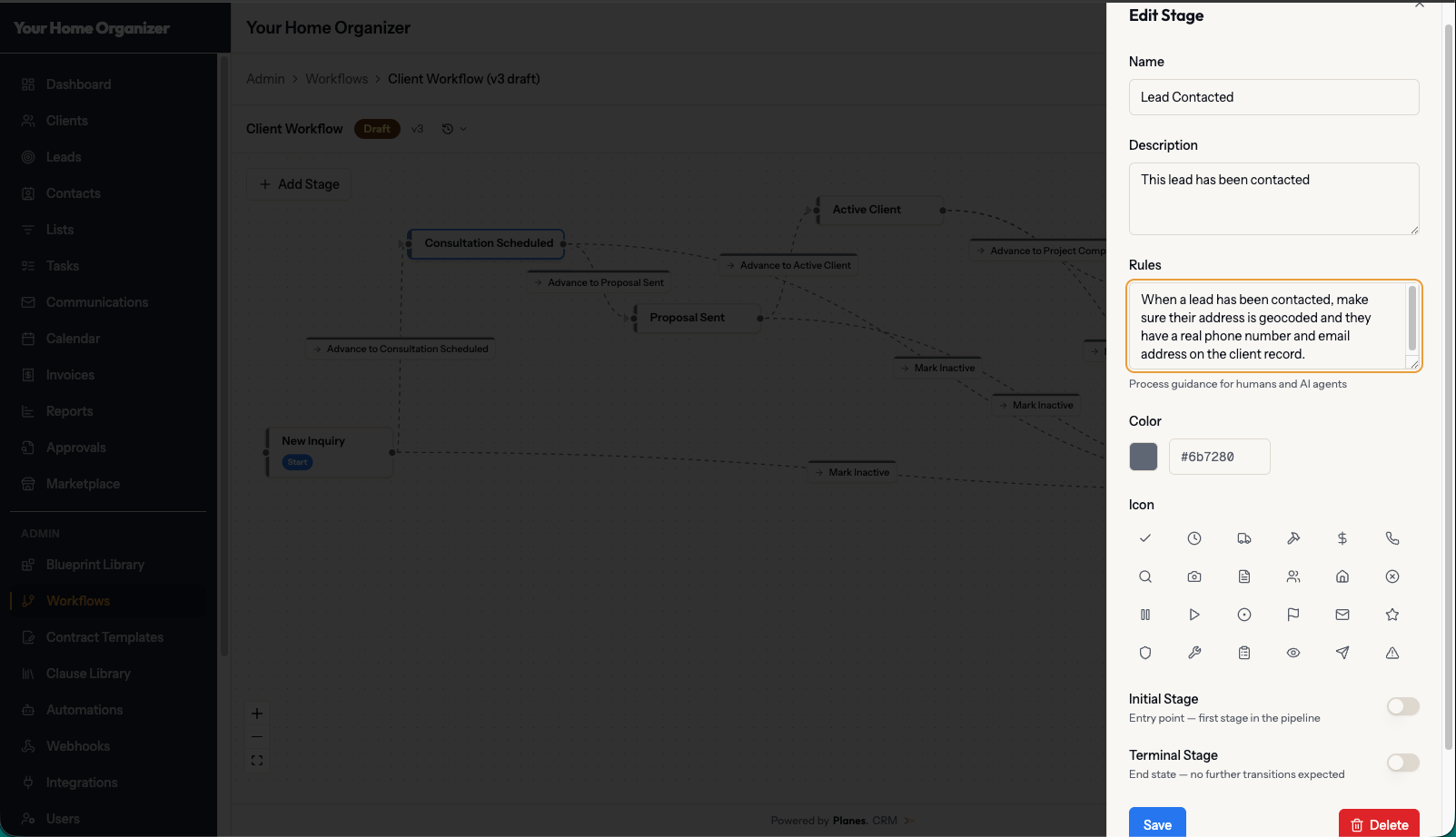
Here's where our imaginary owner — call her Maria — makes it hers. Maria doesn't say "leads," she says inquiries. Rename it. She doesn't do consults for small jobs — but she wants the stage there for whole-house projects. Keep it, and we'll make it skippable in a minute. She thinks in three kinds of work: transformations (big one-time projects), refreshes (small one-timers), and maintenance (recurring).
This is the part to actually watch: we're not filling in settings someone left us. We're dragging stages, renaming them, deleting one, adding one. The pipeline on screen reads like Maria talks.
Minute 6–12: Build the dealbreaker
Every business has the one thing — the nit that made every CRM they tried a hard no. I know this personally: I once helped productize a custom CRM, and every single prospect had a different dealbreaker. It killed the product. It's also why Planes exists.
Maria's nit: maintenance clients. A client finishes a transformation, then converts to a monthly visit — same house, same crew preference, indefinitely. Generic CRMs think everything is a deal that closes once. Maria's best revenue never closes.
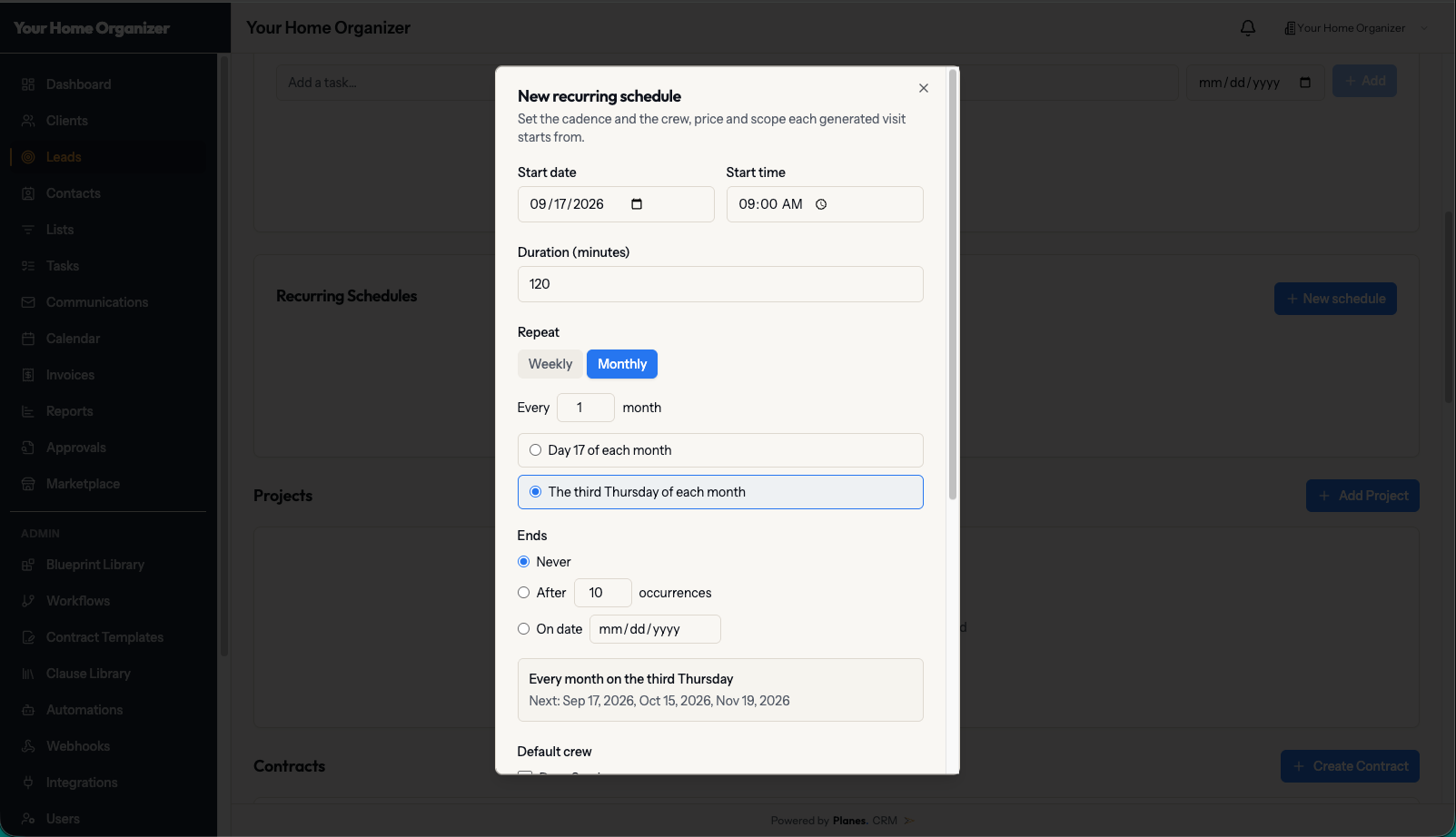
So we build it: a recurring schedule on the client — monthly, tied to the property, visits generating themselves onto the calendar. No spreadsheet. No family-calendar app. The renewal machine is in the system, next to everything else.
Minute 12–16: Bring the crew
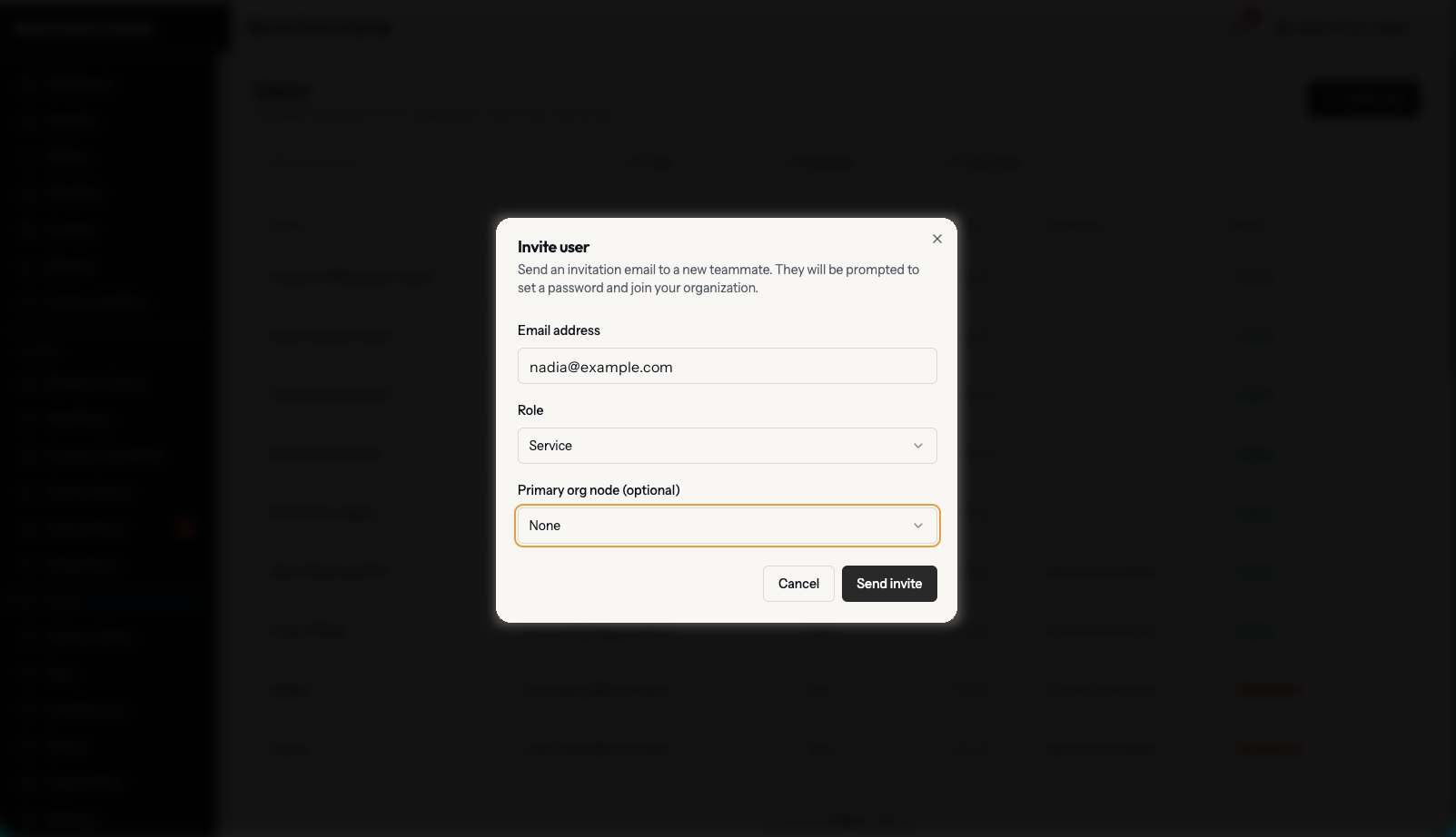
Maria has ten organizers. On per-seat software, this is the moment the price gets absurd, so the crew stays on group texts and the schedule stays fictional. On Planes, seats are free — all ten get accounts, see their visits, and stop texting "where am I tomorrow?"
Twenty seconds per invite. This might be the most valuable four minutes in the whole build.
Minute 16–20: Run a real job through it
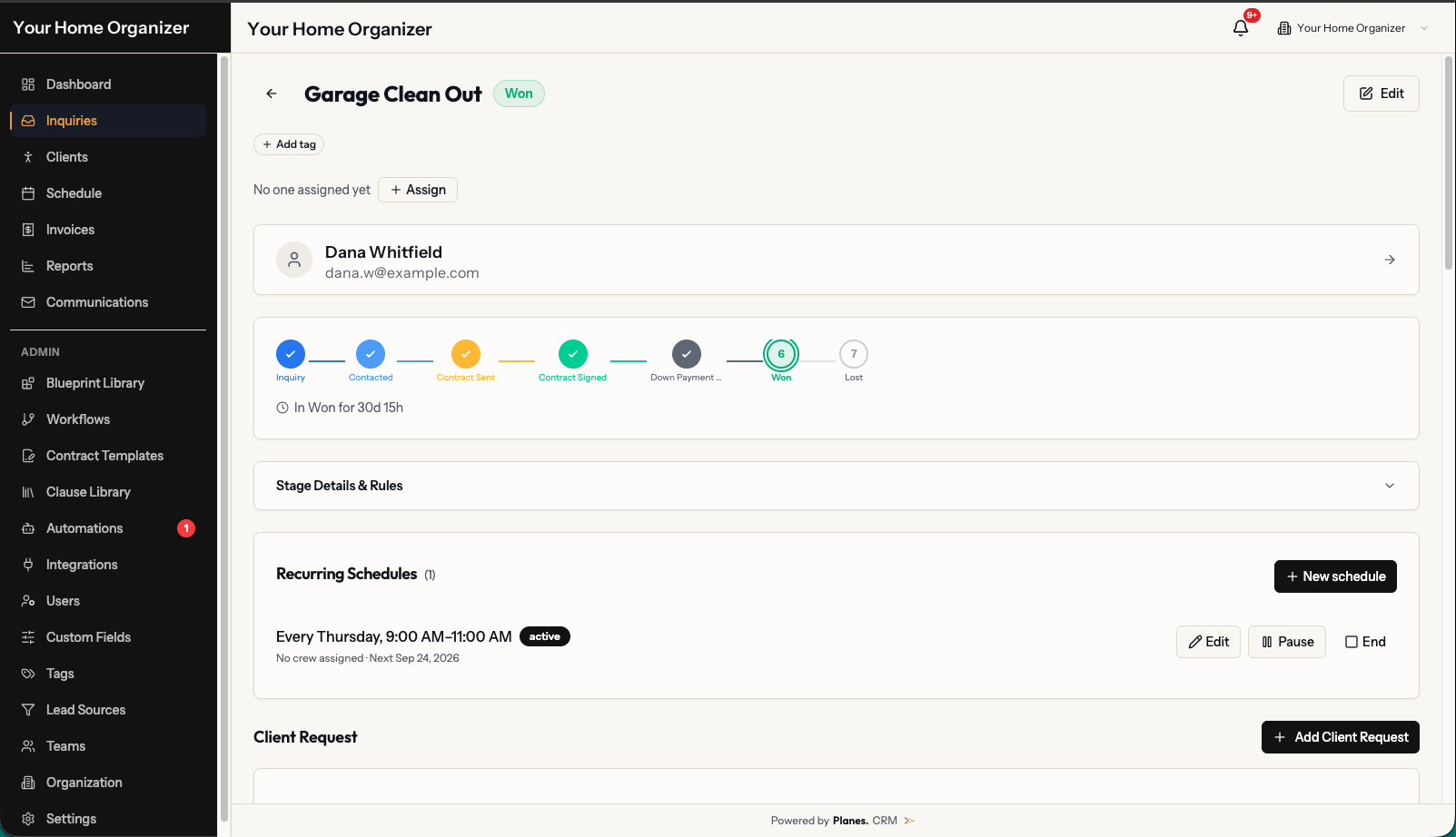
The proof isn't the config screen — it's a job moving. New inquiry from a referral. Skip the consult (she knew what she wanted). Contract sent for signature. Signed; the job schedules; a crew gets assigned; the visit completes; the invoice goes out — all one thread, in Maria's language, through Maria's stages.
Stop the clock.
What just happened
In twenty minutes we built what Maria would have paid a developer months to build: a CRM shaped exactly like her business. Cost so far: $0 — core Planes is free, unlimited users, and stays that way. If Maria later wants e-signatures handled by the platform, or automations chasing her follow-ups, those are a few dollars a month, à la carte. The system is hers either way.
Next in the series: a storm-restoration roofing company — territories, canvassers, and an insurance-claim stage no software has ever heard of. That one's going to be fun.
If you ever wanted to build your own CRM — this is your chance. Request your runway.
See you up there.